Components Lab
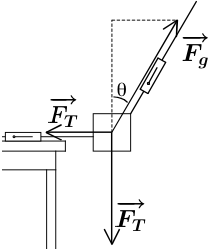
In today's lab, we are going to apply the mathematical methods of trigonometry to a situation with force. You will set up your spring scales as shown to the left, with one of them pulling the weight straight off to the left, and the other pulling off at some unknown angle that is to the right and up.
You know that the gravity force is straight down (- ); in fact, you can measure its
  just once since the weight will not change during the course of the lab. The tension force pointing off to the left is easy to turn into a vector, because it is straight along the -
 direction. The only new and complicated part, therefore, is finding the angle of the right tension force, and using that to find the vector components.
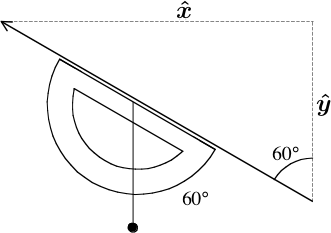
To measure an angle with a protractor, hold the base of the protractor along the string, and read the angle that the plumb bob hangs at. (It might help to
For this lab, you will need:- A 5 N spring scale (the left, horizontal one)
- A 10 N spring scale (the angled one)
- Two weights of different sizes.
Your goal in this lab is to verify that the components you find for a force using trigonometry are indeed what they need to be to correctly balance other forces.
In each trial, you will:- Find and record the for some combination of weights.
- Hold the 10 N scale in such a way that the string from the 5 N scale is perfectly straight (there are many possible angles you could hold it at).
- Being careful not to move the scale, have someone read the force that each scale is pulling with and record them in the table.
- Still without moving the scale, have someone measure the angle θ of the string.
- Calculate the component form of the angled force.
- Verify that if you add all the vectors and get nearly zero.
- Repeat the experiment at a new angle or with a new combination of weights.
I'm hoping that you'll be able to try at least three different angles and different combinations of weights before the end of class. Make sure that eveyone in your group understands how and why you are using the sine and cosine - don't just let one person do all the calculator work and have everyone copy.
| Weight | Horizontal
 | Angled Force | Is it
close? |
|---|
| Size | Angle | Vector form |
|---|
| | | | | |
| | | | | |
| | | | | |
| | | | | |
| | | | | |
Extra Credit: If you manage to record five sets of different angles and weights before the end of class, try out this similar experiment.
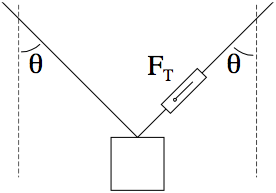
When you hang a block from the middle of a string, allowing it to slide freely along the string, it will always hang in such a way that the angle of each string is the same. (If you're not sure you agree that this is true, go ahead and try it out)
This also means that the force in both strings is the same. Otherwise, the forces on the block would not be balanced. (Again, if you're dubious about this, go ahead and test it with two spring scales)
Record a couple of sets of force vectors for different angles. Then try to explain why it is impossible to get the string completely straight.